Population Ecology of Bottlenose and Heaviside’s Dolphins
Adundance, Population Structure and Habitat Use
In 2008 the NDP began investigating the conservation status, ecological interactions and population structure of dolphins inhabiting the coastal waters of Namibia. Initially, the focus was the endemic Heaviside’s dolphin (Cephalorhynchus heavisidii) and a small resident population of bottlenose dolphins (Tursiops truncatus) in Walvis Bay. Over the years expanded our focus to include dusky dolphins and a secondary site down at Luderitz (the only other harbour in Namibia) and the surrounding NIMPA, which is an ecologically important area for coastal dolphins due to the strong upwelling and resultant rich waters. You can learn about this research in Morgan Martins PhD work and 2021 paper.

Our work has focused in winter seasons when the bottlenose dolphins tend to use the bay more, in summer months they spread out more along the coasts. There are also migratory humpback whales around this time of year. Heaviside’s dolphins come and go with more localised weather conditions like wind strength. Much of this research has already been written up as theses and scientific papers including Elwen et al. 2019 on bottlenose abundance, McGovern et al. 2019 on repeated live strandings, Bridget James’ PhD thesis on social and genetic relationships in the population and multiple papers on the acoustic repertoire, use of signature whistles and impacts of boat noise on acoustic behaviour of these dolphins. you can find these papers on the PUBLICATIONS page. Our results have been fed back to the marine tourism industry so they have the latest available information and can adjust their behaviour to minimise impacts on the dolphins,and has also been used to fed into the development of Ecologically and Biologically Significant Areas (EBSAs) in Namibia which are a key layer in the marine spatial planning process. specifically – the area north of Bird Island off Aphrodite and Longbeach, and the area on the east side of Pelican have been identified as key habitat for bottlenose dolphins for resting and feeding respectively.
Long term population monitoring is necessary to assess conservation efforts so far, provide up to date information for the mitigation of new impacts in the ecosystem and investigate ecological relationships at a broad scale, relevant to impacts such as climate change & ecological regime shift. Already, our data has allowed us to identify a critical resting habitat of bottlenose dolphins in Walvis Bay and negotiate with the marine tourism industry to declare this a ‘no-go’ zone for tour vessels to provide a sanctuary area for animals within Walvis Bay.
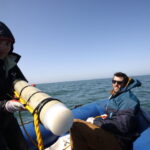
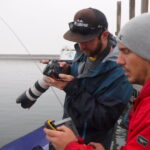
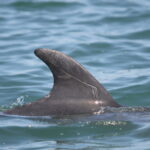
We are using multiple techniques to investigate these populations including visual surveys by small boat to look at space use; moored hydrophones (CPODS) to look at habitat use in core areas over time; photographic identification to assess abundance through mark-recapture techniques and investigate social relationships and how these affect various aspects of the dolphins behaviour and even our data analyses! We are also using stable isotope techniques to investigate changes in diet at broad scales throughout the Benguela ecosystem.